AI & Agents
Agentic AI is software that plans, calls tools and acts toward a goal with limited human input, instead of answering one prompt at a time. These episodes cover agentic AI examples from production: sales agent swarms, coding agents, agent governance and the economics of running agents all day.
All 23 Agentic SaaS Talks episodes about AI & Agents.
AI & Agents episodes
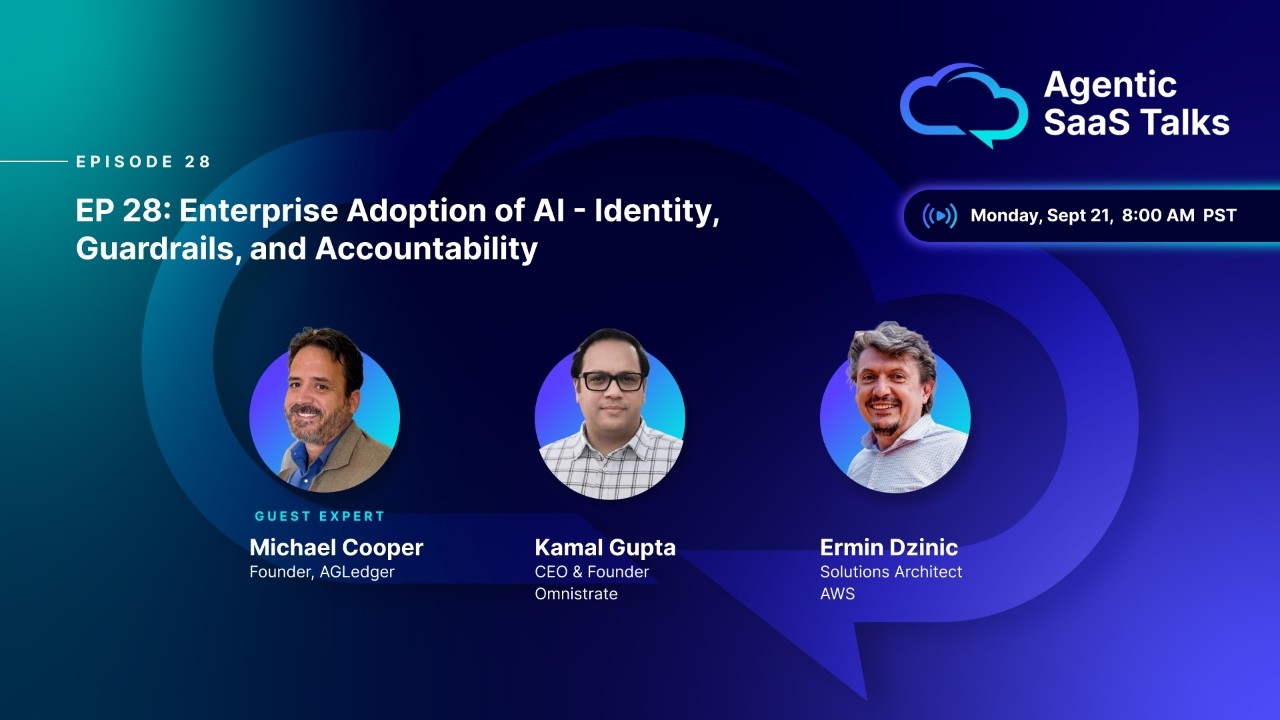
Episode 40: Enterprise Adoption of AI: Identity, Guardrails, and Accountability
Guest host Michael Cooper, founder of AGLedger.ai, returns with Ermin Dzinic and Kamal Gupta to look at what changes when AI agents start taking actions across enterprise systems. Bounded autonomy still rests on familiar principles: identity, least-privilege access, and audit trails that cannot be tampered with. The panel covers why enterprises may favor small, specialized agents, how to record an agent's intent before it acts, how to detect drift, and how structured handoffs between agents keep multi-agent work accountable and cut token costs.

Episode 39: Enterprise Adoption of AI: When AI Starts Writing to the System of Record
Guest host Michael Cooper, founder of AGLedger.ai, joins Bill Tarr and Kamal Gupta to argue that the line that matters for enterprise AI is action, not adoption. He walks the adoption curve from chat and coding copilots through workflow automation, supervised action and bounded autonomy to probabilistic decisioning. The group covers agent identity, why an agent that resets its memory should be treated as a new employee on every run, and why results drift between a Monday and a Saturday. Cooper says enterprises already have four of the five pieces they need and are missing a durable, tamper-evident record of intent, approval and action, and why a log an agent reconstructs afterward is not evidence. Anyone building or buying agents that write to systems of record gets a concrete case for recording intent first.

Episode 38: The Last Mile of AI-SDLC: When Agents Build What Customers Want
Productmind co-founders Steen Brahe and Alessio Nobile take on the last mile of the AI software development lifecycle: getting from a real customer conversation to shipped code without losing the original intent. They demo how a customer call becomes a feature request, then a living specification, then agent-ready tasks running against an existing codebase, with full lineage preserved from feedback to release. The panel also digs into how AI is redrawing product and engineering roles, what governance of human-agent collaboration looks like in the enterprise, and how the founders cleared 20+ bugs with parallel agents while building Productmind with Productmind. For product managers it doubles as a working example of AI for product management: customer feedback turned into specs that coding agents can act on.

Episode 36: Data Consistency for AI: How ScalarDB Unifies Databases and Speeds Migration
Joe McCunney, CEO of Scalar Labs, makes the case that reliable, consistent data across environments is the hidden bottleneck for enterprise AI, especially in large organizations juggling 300+ database types. He explains how ScalarDB acts as a database-agnostic binder that connects multiple data sources and treats them as a single database, and how the company's open source refactoring agent generates architecture docs and migration plans that cut enterprise design time by up to 85%.

Episode 34: Agentic AI Governance in Production: Inside DataRobot's Agent Workforce Platform
Romi Datta, VP and Head of Product Management at DataRobot, explains why enterprise AI is moving past chatbots and copilots toward full agent workforces, and why 95% of agentic AI pilots still fail to deliver measurable ROI. He walks through production use cases from insurance claims processing to industrial safety at Chevron (with NVIDIA edge AI), then breaks down the governance, observability, secure context management, and agent memory an enterprise platform needs to run agents in cloud, hybrid, on-prem, and air-gapped environments.

Episode 33: Open Source Licensing and Survival in the Age of AI, with Joshua Drake
Joshua Drake, President and CTO of Command Prompt with nearly 30 years in the PostgreSQL community, lays out the risks AI creates for open source: extraction without attribution, model collapse, AI-generated security holes, and legal exposure from derivative work. He argues that proof of human contribution, signed origins, and governance with humans in the loop matter more than ever, and shows how commercial open source companies can adopt AI without losing community trust.
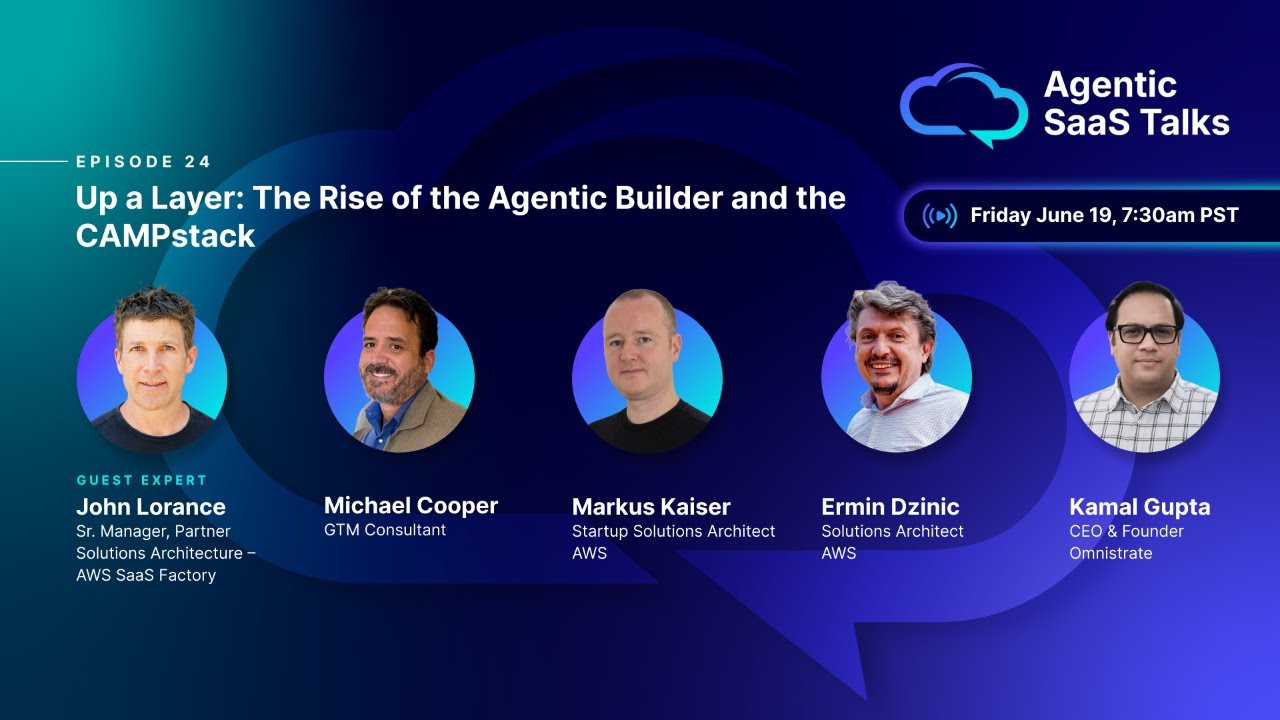
Episode 32: Up a Layer: The Rise of the Agentic Builder and the CAMPstack
The panel unpacks how builders are moving "up a layer", from writing every line of implementation to directing AI agents, composing managed services, and shipping faster on product judgment. They introduce the CAMP stack (Cloud, Agents, Managed services, Platforms) and dig into intent engineering, infrastructure control planes, the token economics of running agents 24/7, and why testing remains the hardest part of AI-generated code. Along the way they trace the shift from vibe coding to agentic engineering and ask whether AI will replace software engineers, junior ones in particular.

Episode 30: Building the Business Behind Open Source AI @ AWS San Francisco [Live]
A live panel recorded at AWS San Francisco bringing together open-source AI founders and builders from Zep AI, DataRobot, Command Prompt, Scalar Labs, StreamNative, and Omnistrate. The group moves past technical specs to share strategic and personal reflections on how open source AI teams deploy, scale, and monetize.
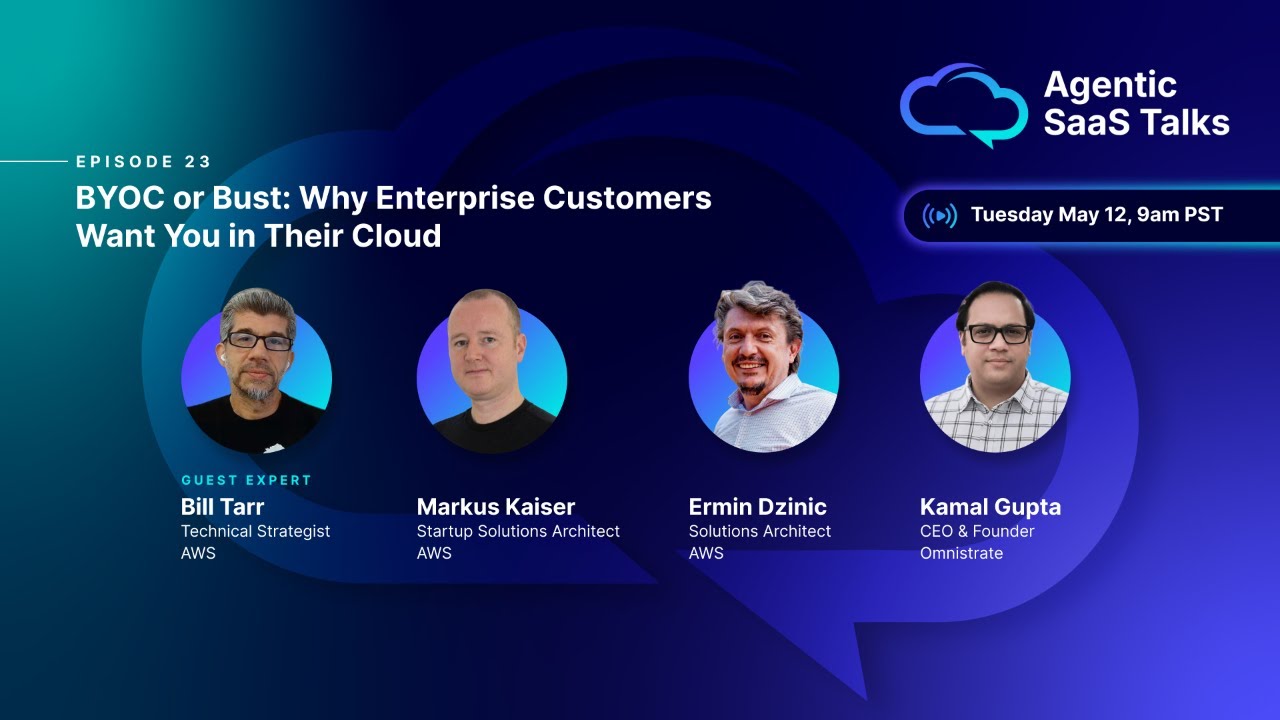
Episode 29: BYOC or Bust: Why Enterprise Customers Want You in Their Cloud
BYOC has shifted from a deployment option to a buying requirement. AWS solutions architects and Omnistrate's Kamal Gupta break down why enterprises now demand software in their own cloud, the security building blocks that make it work, and how agentic AI and data gravity are accelerating the move toward Bring Your Own Cloud.

Episode 27: LLM Tokenomics: New Economics Making 'Cheap' Engineers Expensive
From token leaderboards and LLM FinOps to the rise of the 'Agent Shepherd', the panel unpacks what LLM Tokenomics means for engineering teams and developer productivity. They debate whether tokens are replacing developer time, why AI productivity gains are so inconsistent, and what makes a great engineer when English becomes the new programming language. They also look at what AI token costs do to engineering budgets, and whether SaaS is dead.

Episode 26: The Future of DBaaS in an AI World: Vector Search, Hybrid Retrieval and Postgres
As SaaS evolves for AI, so must the database. AWS's Subbu Ramarao joins the panel to examine how AI-native workloads and agentic access patterns, vector search, hybrid retrieval, and unpredictable agent-generated queries, are reshaping the DBaaS landscape, plus the resurgence of Postgres and how BYOC and pricing pressures are changing managed data services.

Episode 25: Cloud-Native Databases on Kubernetes for AI Agents, with Sergey Pronin
Sergey Pronin, founder of Solanica and former Percona engineer, joins the panel to discuss why the SaaS-only data model is fracturing. The conversation covers 'Dark Matter Data' trapped inside enterprises, treating databases like cattle on Kubernetes, API-driven self-service provisioning, and why donating Open Everest to the CNCF matters for license-stable infrastructure.

Episode 24: Agentic SaaS Talks, 2025 Year in Review
Michael Cooper, Bill Tarr, Markus Kaiser and Ermin Dzinic review 2025 on Agentic SaaS Talks and make predictions for 2026. They trace the show from SaaS Mondays articles to the current name and 19 guest episodes, and Markus recalls AI coding hallucinating functions at the end of 2024 before it became a required skill by April or May. Bill revisits the Rox episode and the one-person unicorn, and the panel covers the HoneySales pivot, John Lorance on abstracting cloud primitives, and digital identity for people and agents. Predictions include fewer acqui-hires, data companies gaining, LLMs becoming commodities, control planes growing in importance, and context engineering as the word of 2026. Listeners get a candid account of what changed for SaaS founders and engineers during 2025.

Episode 20: The Agentic SaaS Executive Summit - Live Event
A live summit at AWS re:Invent in Las Vegas, hosted by Bill Tarr, with two panels. The first asks whether agentic AI is revolution, evolution or hype, with Shriram Sridharan of Rox, Guy Korland of FalkorDB, Mihir Pandya of Scale AI and Alok Nikhil of Omnistrate. It covers seat, usage and outcome-based pricing, the return of bring-your-own-cloud deployments, and enterprise demands for data lineage. The second covers commercializing open source with Peter Farkas and Peter Zaitsev of Percona, Gopi Duddi and Talina Shrotiya of Couchbase, and Kamal Gupta, including open core, license changes that cost communities trust, and foundation-owned projects such as Linux and Kubernetes. Founders deciding how to price agentic software or monetize open source can compare specific positions.

Episode 19: Leaning into Agentic: How HoneySales Pivoted to an AI-Driven Future
Michael Cooper, Markus Kaiser and Ermin Dzinic talk with Denis Zatsepin, CTO of HoneySales, about how the company went from a manual sales service to SaaS and then to a multi-agent product on AWS. The agents build ideal customer profiles, a job that a sales consultant would otherwise do by hand, because customers with a wrong ICP got little from the rest of the pipeline. Denis built the first prototype with the Strands Agents SDK as one container on Fargate behind a load balancer, and had a working application in two to three weeks. An orchestrator agent proved slow and opaque to users, so the team moved to direct chats with specialist agents that sync through a shared workflow tool. Founders and engineering leaders get a concrete account of what a pivot to agents changes in architecture and user experience.

Episode 23: Revolutionizing AI SaaS: Control Plane Innovation and Modern Cloud Models with Anyscale
A conversation filmed at AWS offices in San Francisco about how Anyscale empowers teams to build, scale, and operate complex ML workflows. Covers control plane architecture, the evolution of SaaS, and advice for SaaS founders adapting to the agentic future.

Episode 17: Agentic Architectures: Building AI Apps that Think and Scale
AI applications are evolving from simple prompt-driven tools into agentic systems, intelligent applications that can reason, act, and adapt. But as builders race to bring these apps to market, the same questions keep coming up: What should we build ourselves? What should we leverage from the ecosystem? And how do we operate these apps as a managed service at scale? In this session, our guests unpack the architectural patterns, design choices, and deployment models shaping the next wave of agentic innovation. From front-end frameworks like Vercel + Next.js, to AWS-native AI services, to control planes that automate everything between, this is a blueprint for taking your Agentic App from prototype to managed platform.

Episode 16: From SaaS to Agentic SaaS: Autonomy, Orchestration & Opportunity
Welcome to Agentic SaaS Talks! For the past 16 episodes this series has been known as SaaS Monday, Live on Friday, our deep dives with AWS and some amazing founders and builders on how to design, build and scale great SaaS products. Today we're rebranding to reflect a massive shift in the industry: the rise of agentic systems, AI-driven software that acts autonomously, collaborates intelligently and continuously improves itself.

Episode 12: Founders, Fraud, and the Future of AI with Joshua Mckenty
Joshua McKenty, legendary cloud architect, OpenStack co-founder, and now CEO of Polyguard, joins us for a no-fluff, high-impact conversation on innovating inside NASA, scaling SaaS from scratch (and from the edge), fighting synthetic identity fraud with AI, and why trust, privacy, and infrastructure are converging in 2025.

Episode 11: From Prompt to Product AI with OriginAI CEO
This episode explores how Generative AI is transforming application development, making it faster, more accessible, and more modular. We focus on how platforms like Origin AI are helping founders and product leaders move from idea to working application logic using natural language and structured prompts.

Episode 9: Inside Rox's AI Agent Swarm for Sales Teams, with the CTO
We dive into how Rox is pioneering the world's first enterprise-ready AI Agent Swarm, built to transform how revenue teams operate. Join us as we speak with Shriram Sridharan, co-founder of Rox, about his journey from scaling cloud infrastructure at Confluent and Amazon Aurora to launching a new kind of SaaS platform powered by agent-based AI.

Episode 7: The Spine AI Story with Ashwin Raman
A special Notes from a Founder edition featuring Ashwin Raman, Co-founder and CTO of Spine AI, the world's first iterative deep research platform, built for speed, scale, and substance. Ashwin shares his journey building AI research tools from the ground up.

Episode 1: How will AI Impact SaaS Builders
Michael Cooper hosts Kamal Gupta, Bill Tarr and Markus Kaiser in the first live stream of the show, then called SaaS Mondays, to ask whether AI kills SaaS. The panel says it does not: SaaS is a business model, and Bill Tarr's test for real SaaS is whether a company has a control plane. They cite US VC money going to AI rising from 22% in 2022 to 42% last year, then cover usage-based and outcome-based pricing, including bring-your-own-LLM as a way to cap customer spend. On architecture they discuss per-tenant long-running training jobs with checkpointing on costly GPUs, per-tenant models and RAG, headless SaaS where agents replace the application layer, and tenant isolation. Markus Kaiser adds the European view on data residency. Anyone building or running SaaS gets a practical list of what AI changes in pricing, deployment and multi-tenancy.