
Founders, Fraud, and the Future of AI with Joshua Mckenty
Joshua McKenty, legendary cloud architect, OpenStack co-founder, and now CEO of Polyguard, joins us for a no-fluff, high-impact conversation on innovating inside NASA, scaling SaaS from scratch (and from the edge), fighting synthetic identity fraud with AI, and why trust, privacy, and infrastructure are converging in 2025.
Special Guests
Joshua McKenty
CEO of Polyguard AI, OpenStack co-founder, and former cloud architect at NASA. Pioneer in cloud infrastructure and now tackling synthetic identity fraud.
Timestamps
00:00Intro: Identity, Security & the AI Shift05:12Why All Cybersecurity Is an Identity Problem10:43The Internet's Original Sin: Anonymity vs Accountability15:10Remote Hiring Fraud & North Korea Sanctions19:33How Polyguard AI Verifies Identity in Video & Remote Hiring24:00SaaS, Privacy Trade-offs & User Data Vulnerabilities29:12AI Agents, Identity Delegation & the New Trust Crisis34:40Beyond OAuth: Scoped Tokens & Chain of Trust39:26Why Blockchain Can't Solve Identity44:15Centralized Identity: Nation States vs Big Tech vs Polyguard AI49:05Agent-Based Commerce & Real-World Identity53:30What We Learned from AI This Week (Tools & Trends)59:48Cloud Code, Cursor & Spec-First AI Development1:04:00Closing: MCP, Agents & Polyguard AI's Role in the FutureAbout This Episode
- What is "Founders, Fraud, and the Future of AI with Joshua Mckenty" about?
- Joshua McKenty, legendary cloud architect, OpenStack co-founder, and now CEO of Polyguard, joins us for a no-fluff, high-impact conversation on innovating inside NASA, scaling SaaS from scratch (and from the edge), fighting synthetic identity fraud with AI, and why trust, privacy, and infrastructure are converging in 2025.
- What topics does this episode cover?
- This episode is filed under AI & Agents, Security & Identity, Founder Stories on Agentic SaaS Talks.
- How long is this episode, and when was it published?
- "Founders, Fraud, and the Future of AI with Joshua Mckenty" runs 68 min and was published on October 21, 2024.
- Who is featured in this episode?
- This episode features Joshua McKenty as a guest, in conversation with the Agentic SaaS Talks hosts.
- What are the key moments in this episode?
- Key moments include: Why All Cybersecurity Is an Identity Problem; The Internet's Original Sin: Anonymity vs Accountability; Remote Hiring Fraud & North Korea Sanctions; How Polyguard AI Verifies Identity in Video & Remote Hiring; SaaS, Privacy Trade-offs & User Data Vulnerabilities; AI Agents, Identity Delegation & the New Trust Crisis; Beyond OAuth: Scoped Tokens & Chain of Trust; Why Blockchain Can't Solve Identity. The timestamps on this page jump to each one on YouTube.
Related Episodes
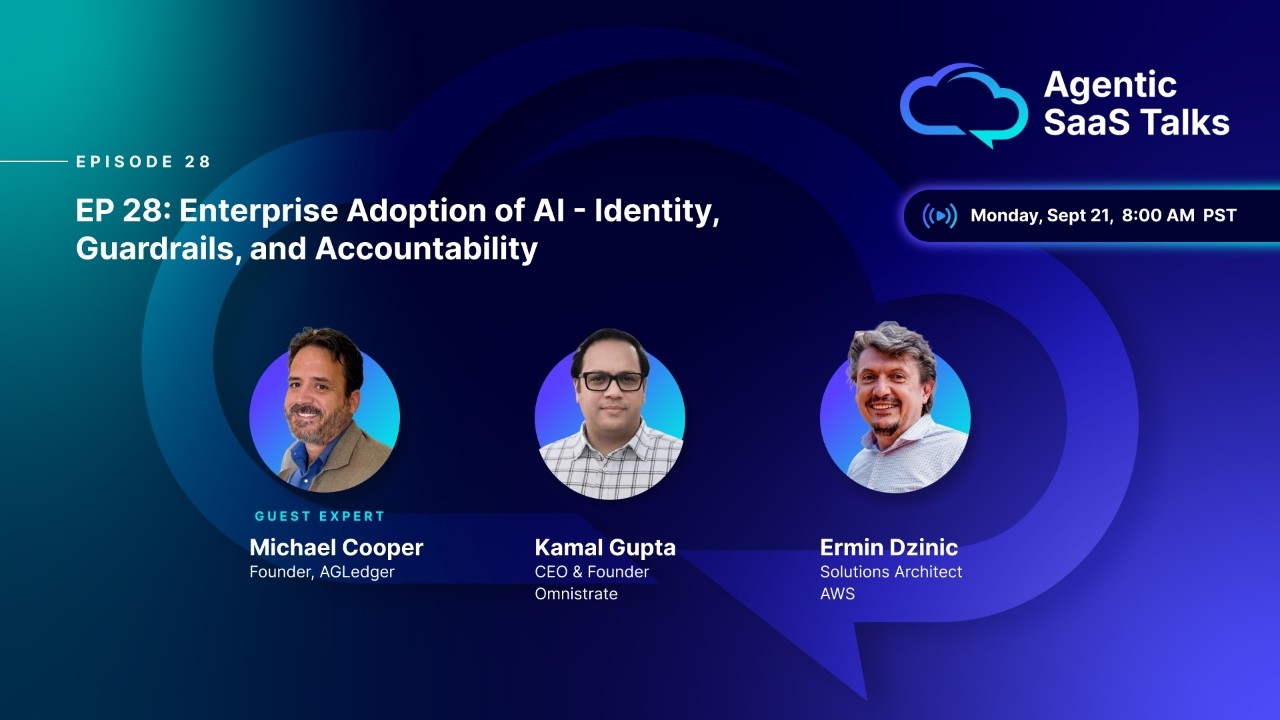
Episode 40: Enterprise Adoption of AI: Identity, Guardrails, and Accountability
Guest host Michael Cooper, founder of AGLedger.ai, returns with Ermin Dzinic and Kamal Gupta to look at what changes when AI agents start taking actions across enterprise systems. Bounded autonomy still rests on familiar principles: identity, least-privilege access, and audit trails that cannot be tampered with. The panel covers why enterprises may favor small, specialized agents, how to record an agent's intent before it acts, how to detect drift, and how structured handoffs between agents keep multi-agent work accountable and cut token costs.

Episode 38: The Last Mile of AI-SDLC: When Agents Build What Customers Want
Productmind co-founders Steen Brahe and Alessio Nobile take on the last mile of the AI software development lifecycle: getting from a real customer conversation to shipped code without losing the original intent. They demo how a customer call becomes a feature request, then a living specification, then agent-ready tasks running against an existing codebase, with full lineage preserved from feedback to release. The panel also digs into how AI is redrawing product and engineering roles, what governance of human-agent collaboration looks like in the enterprise, and how the founders cleared 20+ bugs with parallel agents while building Productmind with Productmind. For product managers it doubles as a working example of AI for product management: customer feedback turned into specs that coding agents can act on.

Episode 33: Open Source Licensing and Survival in the Age of AI, with Joshua Drake
Joshua Drake, President and CTO of Command Prompt with nearly 30 years in the PostgreSQL community, lays out the risks AI creates for open source: extraction without attribution, model collapse, AI-generated security holes, and legal exposure from derivative work. He argues that proof of human contribution, signed origins, and governance with humans in the loop matter more than ever, and shows how commercial open source companies can adopt AI without losing community trust.