
How will AI Impact SaaS Builders
Michael Cooper hosts Kamal Gupta, Bill Tarr and Markus Kaiser in the first live stream of the show, then called SaaS Mondays, to ask whether AI kills SaaS. The panel says it does not: SaaS is a business model, and Bill Tarr's test for real SaaS is whether a company has a control plane. They cite US VC money going to AI rising from 22% in 2022 to 42% last year, then cover usage-based and outcome-based pricing, including bring-your-own-LLM as a way to cap customer spend. On architecture they discuss per-tenant long-running training jobs with checkpointing on costly GPUs, per-tenant models and RAG, headless SaaS where agents replace the application layer, and tenant isolation. Markus Kaiser adds the European view on data residency. Anyone building or running SaaS gets a practical list of what AI changes in pricing, deployment and multi-tenancy.
Timestamps
00:00Stream opens: welcome to the first live SaaS show05:30Panel introductions from AWS and startup backgrounds08:30Is SaaS dead now that AI agents have arrived?11:00What is agentic SaaS, and where is VC money going?15:30Why SaaS is a business model and the control plane test20:30Will AI change SaaS billing and pricing models?26:00Pay-per-use fears, bring your own LLM, outcome pricing29:00Adding a pre-trained LLM versus training one in SaaS31:30Per-tenant long-running AI jobs and GPU checkpointing34:00Deploying agents in customer accounts with per-tenant RAG36:00What is headless SaaS and the agent layer?38:30Designing data access for AI agents: Moscow example47:00Why build multi-tenancy and the control plane from day one53:00European data residency and privacy for AI agents57:00Closing thoughts: startups, enterprises and VC efficiencyAbout This Episode
- What is "How will AI Impact SaaS Builders" about?
- Michael Cooper hosts Kamal Gupta, Bill Tarr and Markus Kaiser in the first live stream of the show, then called SaaS Mondays, to ask whether AI kills SaaS. The panel says it does not: SaaS is a business model, and Bill Tarr's test for real SaaS is whether a company has a control plane. They cite US VC money going to AI rising from 22% in 2022 to 42% last year, then cover usage-based and outcome-based pricing, including bring-your-own-LLM as a way to cap customer spend. On architecture they discuss per-tenant long-running training jobs with checkpointing on costly GPUs, per-tenant models and RAG, headless SaaS where agents replace the application layer, and tenant isolation. Markus Kaiser adds the European view on data residency. Anyone building or running SaaS gets a practical list of what AI changes in pricing, deployment and multi-tenancy.
- What topics does this episode cover?
- This episode is filed under AI & Agents, SaaS Strategy on Agentic SaaS Talks.
- How long is this episode, and when was it published?
- "How will AI Impact SaaS Builders" runs 64 min and was published on July 1, 2024.
- What are the key moments in this episode?
- Key moments include: Stream opens: welcome to the first live SaaS show; Panel introductions from AWS and startup backgrounds; Is SaaS dead now that AI agents have arrived?; What is agentic SaaS, and where is VC money going?; Why SaaS is a business model and the control plane test; Will AI change SaaS billing and pricing models?; Pay-per-use fears, bring your own LLM, outcome pricing; Adding a pre-trained LLM versus training one in SaaS. The timestamps on this page jump to each one on YouTube.
Related Episodes

Episode 39: Enterprise Adoption of AI: When AI Starts Writing to the System of Record
Guest host Michael Cooper, founder of AGLedger.ai, joins Bill Tarr and Kamal Gupta to argue that the line that matters for enterprise AI is action, not adoption. He walks the adoption curve from chat and coding copilots through workflow automation, supervised action and bounded autonomy to probabilistic decisioning. The group covers agent identity, why an agent that resets its memory should be treated as a new employee on every run, and why results drift between a Monday and a Saturday. Cooper says enterprises already have four of the five pieces they need and are missing a durable, tamper-evident record of intent, approval and action, and why a log an agent reconstructs afterward is not evidence. Anyone building or buying agents that write to systems of record gets a concrete case for recording intent first.

Episode 34: Agentic AI Governance in Production: Inside DataRobot's Agent Workforce Platform
Romi Datta, VP and Head of Product Management at DataRobot, explains why enterprise AI is moving past chatbots and copilots toward full agent workforces, and why 95% of agentic AI pilots still fail to deliver measurable ROI. He walks through production use cases from insurance claims processing to industrial safety at Chevron (with NVIDIA edge AI), then breaks down the governance, observability, secure context management, and agent memory an enterprise platform needs to run agents in cloud, hybrid, on-prem, and air-gapped environments.
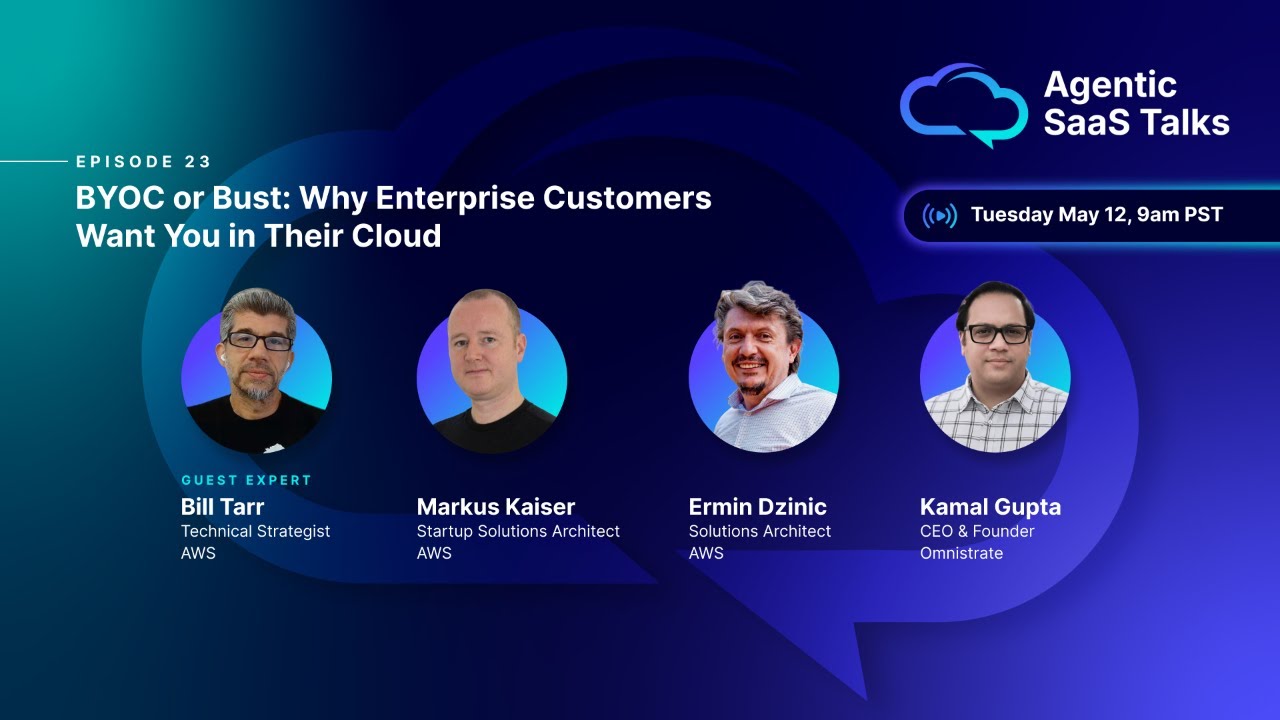
Episode 29: BYOC or Bust: Why Enterprise Customers Want You in Their Cloud
BYOC has shifted from a deployment option to a buying requirement. AWS solutions architects and Omnistrate's Kamal Gupta break down why enterprises now demand software in their own cloud, the security building blocks that make it work, and how agentic AI and data gravity are accelerating the move toward Bring Your Own Cloud.