
Agentic AI Governance in Production: Inside DataRobot's Agent Workforce Platform
Romi Datta, VP and Head of Product Management at DataRobot, explains why enterprise AI is moving past chatbots and copilots toward full agent workforces, and why 95% of agentic AI pilots still fail to deliver measurable ROI. He walks through production use cases from insurance claims processing to industrial safety at Chevron (with NVIDIA edge AI), then breaks down the governance, observability, secure context management, and agent memory an enterprise platform needs to run agents in cloud, hybrid, on-prem, and air-gapped environments.
Special Guests
Romi Datta
VP and Head of Product Management at DataRobot.
Timestamps
00:00Introduction: Building the Business Behind Open Source AI00:04Meet Romi Datta and the DataRobot Agent Workforce Platform00:37What Is DataRobot?00:55Agents as the Modern Workforce01:18DataRobot's Evolution from AutoML to Agentic AI01:58Enterprise Customers Using DataRobot02:29How Agentic AI Has Evolved Over the Last 18 to 24 Months02:55From Chatbots and Copilots to Autonomous Agents03:43What Makes an AI Agent Different?04:12Where Enterprise Agents Create Value04:32Reimagining Business Processes with Agentic AI05:02DataRobot's Agent Marketplace05:22Production-Ready AI Agents for Business Outcomes05:49Claims Processing Agent Example06:22How AI Agents Support Claims Adjudication07:08Reimagining Insurance Claims Processing07:51Industrial AI Use Case: Chevron and Field Safety08:43NVIDIA, DataRobot, and Chevron Partnership09:30Edge AI for Safer Industrial Operations10:30Continuous Safety Validation with Agents11:11Plume Prediction and Drone Route Planning12:09Agent Workflow with NVIDIA NeMo and PhysicsNeMo13:09Guardrails, Monitoring, and Safety Standards14:09Open-Source AI Components Behind the Chevron Use Case14:43Why Enterprises Need Purpose-Built AI Platforms15:17Lessons from Industrialization: Cars, Software, and AI16:57Why 95% of Enterprise Agentic AI Pilots Fail17:23What It Takes to Move Agents to Production17:47Data, Architecture, RBAC, Observability, and Governance18:16Why Agents Can Take 12 to 16 Months to Reach Production18:32Operating and Governing Agents in Any Environment18:56Runtime, Inference, Governance, and Monitoring19:33Secure Context Management, RAG, Identity, and Agent Memory20:02Building Agents Anywhere, Deploying with DataRobot20:28Tracing, Monitoring, and Evaluating Agent Execution20:52DataRobot and NVIDIA Integration21:23Deploying, Scaling, and Governing Enterprise Agents21:52The Future of Agentic AI and Drug Discovery22:42Accelerating Drug Discovery with AI23:44Closing ThoughtsAbout This Episode
- What is "Agentic AI Governance in Production: Inside DataRobot's Agent Workforce Platform" about?
- Romi Datta, VP and Head of Product Management at DataRobot, explains why enterprise AI is moving past chatbots and copilots toward full agent workforces, and why 95% of agentic AI pilots still fail to deliver measurable ROI. He walks through production use cases from insurance claims processing to industrial safety at Chevron (with NVIDIA edge AI), then breaks down the governance, observability, secure context management, and agent memory an enterprise platform needs to run agents in cloud, hybrid, on-prem, and air-gapped environments.
- What topics does this episode cover?
- This episode is filed under AI & Agents, AI Architecture, SaaS Strategy on Agentic SaaS Talks.
- How long is this episode, and when was it published?
- "Agentic AI Governance in Production: Inside DataRobot's Agent Workforce Platform" runs 29 min and was published on July 10, 2026.
- Who is featured in this episode?
- This episode features Romi Datta as a guest, in conversation with the Agentic SaaS Talks hosts.
- What are the key moments in this episode?
- Key moments include: Meet Romi Datta and the DataRobot Agent Workforce Platform; What Is DataRobot?; Agents as the Modern Workforce; DataRobot's Evolution from AutoML to Agentic AI; Enterprise Customers Using DataRobot; How Agentic AI Has Evolved Over the Last 18 to 24 Months; From Chatbots and Copilots to Autonomous Agents; What Makes an AI Agent Different?. The timestamps on this page jump to each one on YouTube.
Related Episodes

Episode 39: Enterprise Adoption of AI: When AI Starts Writing to the System of Record
Guest host Michael Cooper, founder of AGLedger.ai, joins Bill Tarr and Kamal Gupta to argue that the line that matters for enterprise AI is action, not adoption. He walks the adoption curve from chat and coding copilots through workflow automation, supervised action and bounded autonomy to probabilistic decisioning. The group covers agent identity, why an agent that resets its memory should be treated as a new employee on every run, and why results drift between a Monday and a Saturday. Cooper says enterprises already have four of the five pieces they need and are missing a durable, tamper-evident record of intent, approval and action, and why a log an agent reconstructs afterward is not evidence. Anyone building or buying agents that write to systems of record gets a concrete case for recording intent first.

Episode 17: Agentic Architectures: Building AI Apps that Think and Scale
AI applications are evolving from simple prompt-driven tools into agentic systems, intelligent applications that can reason, act, and adapt. But as builders race to bring these apps to market, the same questions keep coming up: What should we build ourselves? What should we leverage from the ecosystem? And how do we operate these apps as a managed service at scale? In this session, our guests unpack the architectural patterns, design choices, and deployment models shaping the next wave of agentic innovation. From front-end frameworks like Vercel + Next.js, to AWS-native AI services, to control planes that automate everything between, this is a blueprint for taking your Agentic App from prototype to managed platform.
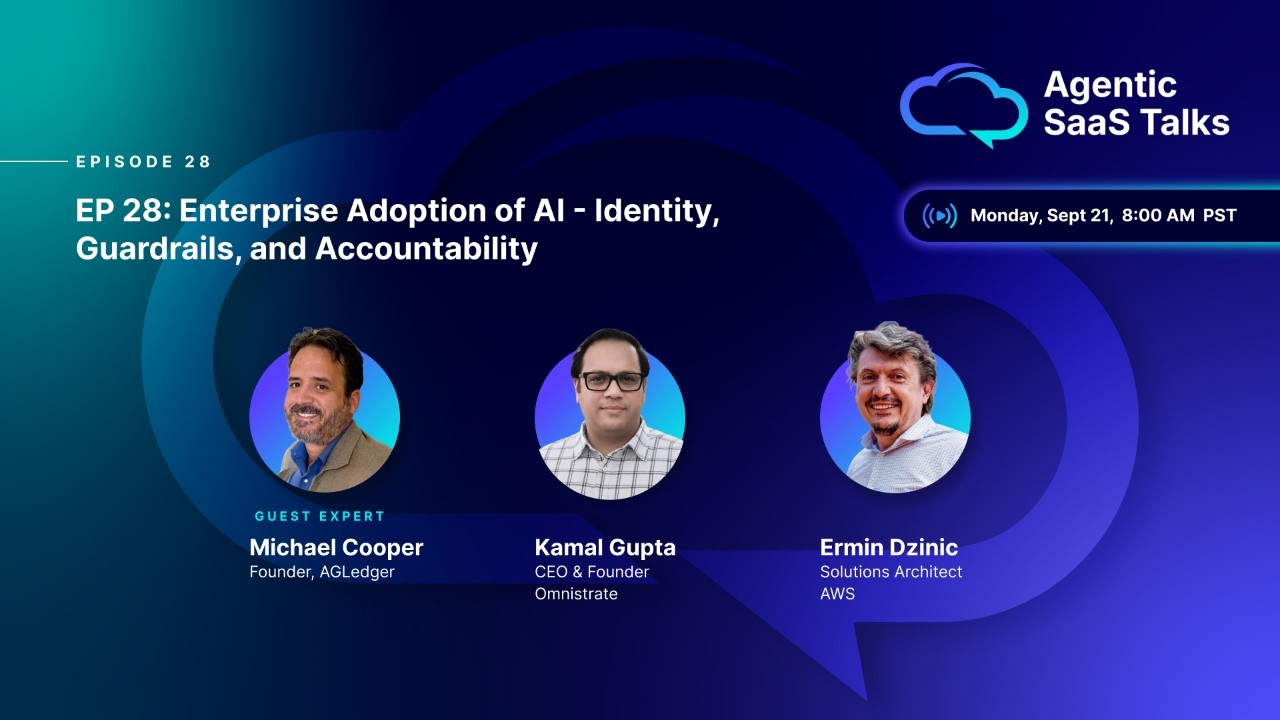
Episode 40: Enterprise Adoption of AI: Identity, Guardrails, and Accountability
Guest host Michael Cooper, founder of AGLedger.ai, returns with Ermin Dzinic and Kamal Gupta to look at what changes when AI agents start taking actions across enterprise systems. Bounded autonomy still rests on familiar principles: identity, least-privilege access, and audit trails that cannot be tampered with. The panel covers why enterprises may favor small, specialized agents, how to record an agent's intent before it acts, how to detect drift, and how structured handoffs between agents keep multi-agent work accountable and cut token costs.