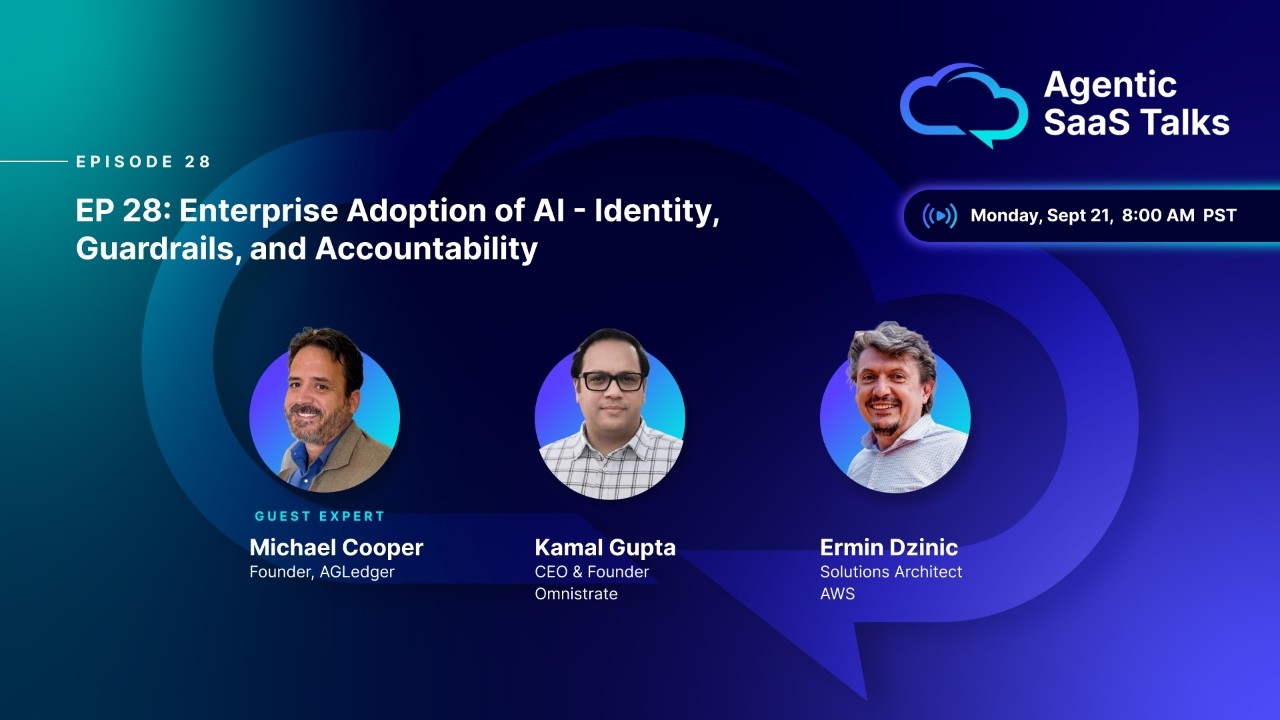
Enterprise Adoption of AI: Identity, Guardrails, and Accountability
Guest host Michael Cooper, founder of AGLedger.ai, returns with Ermin Dzinic and Kamal Gupta to look at what changes when AI agents start taking actions across enterprise systems. Bounded autonomy still rests on familiar principles: identity, least-privilege access, and audit trails that cannot be tampered with. The panel covers why enterprises may favor small, specialized agents, how to record an agent's intent before it acts, how to detect drift, and how structured handoffs between agents keep multi-agent work accountable and cut token costs.
Timestamps
00:00Enterprise AI Agents: Security, Identity, and Governance01:35How Do You Measure Enterprise AI Adoption?02:45What Is Bounded Autonomy in AI Agents?06:12How AGLedger Tracks and Governs AI Agent Actions07:11How Are AI Agents Different from Traditional Machine Learning?12:30How Do You Manage AI Agent Identity and Permissions?16:26Multi-Agent Orchestration: Handoffs and Accountability18:04Why Use Small, Specialized AI Agents?20:25How Do You Detect AI Agent Drift?21:35Why Record AI Agent Intent Before Execution?23:15Software Engineering Principles for Secure AI Agents27:14How Agent Runtime and Context Affect Identity31:25How Do Memory and Context Affect AI Agent Reliability?35:37How Do You Keep AI Agent Audit Logs Tamper-Proof?37:54How Structured Agent Handoffs Can Reduce Token Costs41:11How Do AI Agents Communicate and Share Contracts?42:07Key Takeaways for Enterprise AI AdoptionAbout This Episode
- What is "Enterprise Adoption of AI: Identity, Guardrails, and Accountability" about?
- Guest host Michael Cooper, founder of AGLedger.ai, returns with Ermin Dzinic and Kamal Gupta to look at what changes when AI agents start taking actions across enterprise systems. Bounded autonomy still rests on familiar principles: identity, least-privilege access, and audit trails that cannot be tampered with. The panel covers why enterprises may favor small, specialized agents, how to record an agent's intent before it acts, how to detect drift, and how structured handoffs between agents keep multi-agent work accountable and cut token costs.
- What topics does this episode cover?
- This episode is filed under AI & Agents, Security & Identity, AI Architecture on Agentic SaaS Talks.
- How long is this episode, and when was it published?
- "Enterprise Adoption of AI: Identity, Guardrails, and Accountability" runs 43 min and was published on September 21, 2026.
- What are the key moments in this episode?
- Key moments include: Enterprise AI Agents: Security, Identity, and Governance; How Do You Measure Enterprise AI Adoption?; What Is Bounded Autonomy in AI Agents?; How AGLedger Tracks and Governs AI Agent Actions; How Are AI Agents Different from Traditional Machine Learning?; How Do You Manage AI Agent Identity and Permissions?; Multi-Agent Orchestration: Handoffs and Accountability; Why Use Small, Specialized AI Agents?. The timestamps on this page jump to each one on YouTube.
Related Episodes

Episode 39: Enterprise Adoption of AI: When AI Starts Writing to the System of Record
Guest host Michael Cooper, founder of AGLedger.ai, joins Bill Tarr and Kamal Gupta to argue that the line that matters for enterprise AI is action, not adoption. He walks the adoption curve from chat and coding copilots through workflow automation, supervised action and bounded autonomy to probabilistic decisioning. The group covers agent identity, why an agent that resets its memory should be treated as a new employee on every run, and why results drift between a Monday and a Saturday. Cooper says enterprises already have four of the five pieces they need and are missing a durable, tamper-evident record of intent, approval and action, and why a log an agent reconstructs afterward is not evidence. Anyone building or buying agents that write to systems of record gets a concrete case for recording intent first.

Episode 37: BYOC Anywhere: 10 Principles for Secure Bring Your Own Cloud Deployment
Paul Paliychuk of Zep AI and Omnistrate co-founder Alok Nikhil lay out ten principles for secure Bring Your Own Cloud deployment: keep the data plane in the customer's account, connect without exposing it, swap static credentials for short-lived identity, and make vendor access revocable by design. They walk through the four levels of BYOC, what changes inside air-gapped environments, and why AI products hit the enterprise security bar far earlier in their life than previous generations of SaaS did. The episode closes with a live demo that turns a Helm chart into a BYOC offering with a self-service customer portal. If you are asking what BYOC means in practice, this is the checklist: the software runs in the customer's cloud account, the vendor operates it, and the customer keeps control of access.

Episode 34: Agentic AI Governance in Production: Inside DataRobot's Agent Workforce Platform
Romi Datta, VP and Head of Product Management at DataRobot, explains why enterprise AI is moving past chatbots and copilots toward full agent workforces, and why 95% of agentic AI pilots still fail to deliver measurable ROI. He walks through production use cases from insurance claims processing to industrial safety at Chevron (with NVIDIA edge AI), then breaks down the governance, observability, secure context management, and agent memory an enterprise platform needs to run agents in cloud, hybrid, on-prem, and air-gapped environments.