Cloud Infrastructure
BYOC (Bring Your Own Cloud) runs a vendor's software inside the customer's own cloud account while the vendor still operates it. These episodes cover BYOC, SaaS control planes, air-gapped deployment and delivering software across AWS, other clouds and on-prem.
All 14 Agentic SaaS Talks episodes about Cloud Infrastructure.
Cloud Infrastructure episodes

Episode 37: BYOC Anywhere: 10 Principles for Secure Bring Your Own Cloud Deployment
Paul Paliychuk of Zep AI and Omnistrate co-founder Alok Nikhil lay out ten principles for secure Bring Your Own Cloud deployment: keep the data plane in the customer's account, connect without exposing it, swap static credentials for short-lived identity, and make vendor access revocable by design. They walk through the four levels of BYOC, what changes inside air-gapped environments, and why AI products hit the enterprise security bar far earlier in their life than previous generations of SaaS did. The episode closes with a live demo that turns a Helm chart into a BYOC offering with a self-service customer portal. If you are asking what BYOC means in practice, this is the checklist: the software runs in the customer's cloud account, the vendor operates it, and the customer keeps control of access.

Episode 36: Data Consistency for AI: How ScalarDB Unifies Databases and Speeds Migration
Joe McCunney, CEO of Scalar Labs, makes the case that reliable, consistent data across environments is the hidden bottleneck for enterprise AI, especially in large organizations juggling 300+ database types. He explains how ScalarDB acts as a database-agnostic binder that connects multiple data sources and treats them as a single database, and how the company's open source refactoring agent generates architecture docs and migration plans that cut enterprise design time by up to 85%.

Episode 35: The Founder's Guide to Scaling Open Source AI Products to Production on AWS
Omnistrate co-founders Kamal Gupta and Alok Nikhil map the road from open source adoption to revenue: the four ingredients of monetization (project, enterprise features, distribution, go-to-market) and the three business models open to open source AI companies, product-led growth, AWS Marketplace co-sell, and enterprise sales. Alok closes with a live demo that turns vLLM into a managed inference service with a self-service customer portal, showing why distribution needs a control plane and why a Marketplace listing alone gets you discovered but not paid.
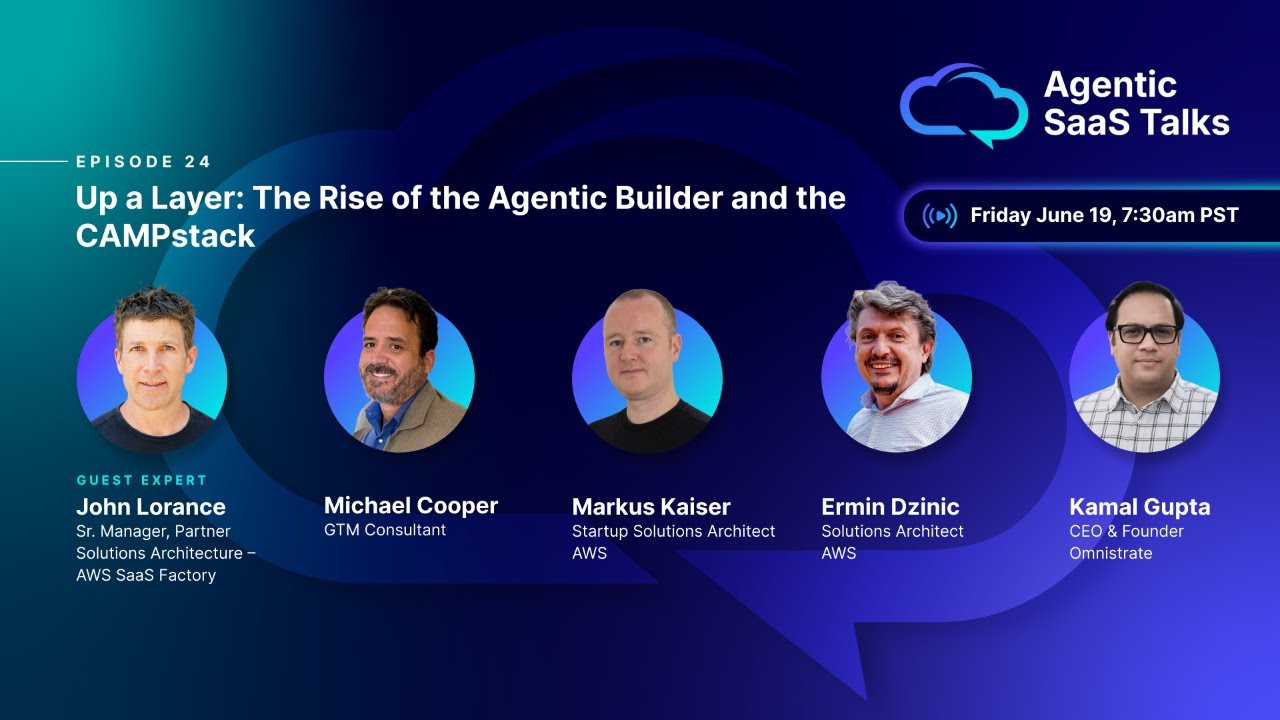
Episode 32: Up a Layer: The Rise of the Agentic Builder and the CAMPstack
The panel unpacks how builders are moving "up a layer", from writing every line of implementation to directing AI agents, composing managed services, and shipping faster on product judgment. They introduce the CAMP stack (Cloud, Agents, Managed services, Platforms) and dig into intent engineering, infrastructure control planes, the token economics of running agents 24/7, and why testing remains the hardest part of AI-generated code. Along the way they trace the shift from vibe coding to agentic engineering and ask whether AI will replace software engineers, junior ones in particular.

Episode 31: Building BYOC for Fortune 500: The Real Story of Enterprise AI Deployment
Daniel Chalef, founder and CEO of Zep AI, walks through the brutal technical reality of deploying AI products into Fortune 500 environments, zero-trust architectures, Service Control Policies, no-egress VPCs, and broken image supply chains. He explains why pure SaaS AI products can't meet enterprise security bars and how Bring Your Own Cloud (BYOC) deployments actually get shipped into locked-down customer infrastructure. For vendors taking private AI into regulated customers, it shows what near air-gapped, no-egress environments demand.
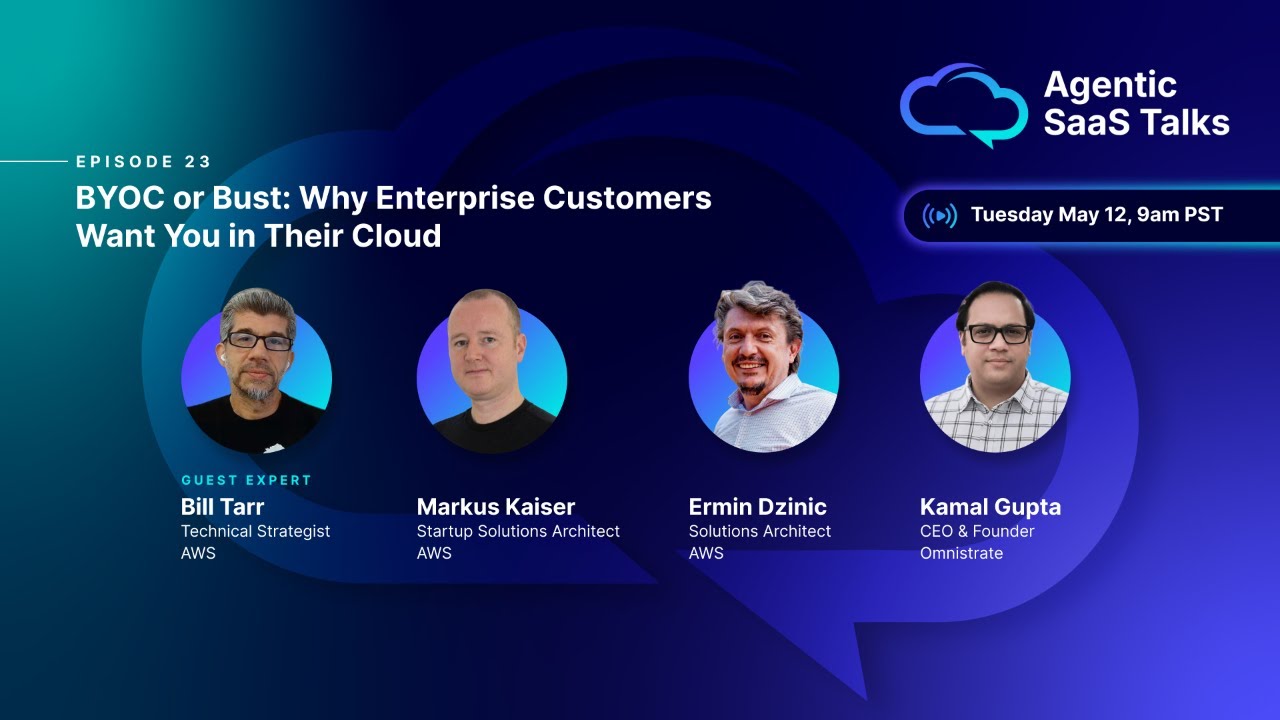
Episode 29: BYOC or Bust: Why Enterprise Customers Want You in Their Cloud
BYOC has shifted from a deployment option to a buying requirement. AWS solutions architects and Omnistrate's Kamal Gupta break down why enterprises now demand software in their own cloud, the security building blocks that make it work, and how agentic AI and data gravity are accelerating the move toward Bring Your Own Cloud.

Episode 26: The Future of DBaaS in an AI World: Vector Search, Hybrid Retrieval and Postgres
As SaaS evolves for AI, so must the database. AWS's Subbu Ramarao joins the panel to examine how AI-native workloads and agentic access patterns, vector search, hybrid retrieval, and unpredictable agent-generated queries, are reshaping the DBaaS landscape, plus the resurgence of Postgres and how BYOC and pricing pressures are changing managed data services.

Episode 24: Agentic SaaS Talks, 2025 Year in Review
Michael Cooper, Bill Tarr, Markus Kaiser and Ermin Dzinic review 2025 on Agentic SaaS Talks and make predictions for 2026. They trace the show from SaaS Mondays articles to the current name and 19 guest episodes, and Markus recalls AI coding hallucinating functions at the end of 2024 before it became a required skill by April or May. Bill revisits the Rox episode and the one-person unicorn, and the panel covers the HoneySales pivot, John Lorance on abstracting cloud primitives, and digital identity for people and agents. Predictions include fewer acqui-hires, data companies gaining, LLMs becoming commodities, control planes growing in importance, and context engineering as the word of 2026. Listeners get a candid account of what changed for SaaS founders and engineers during 2025.

Episode 18: Deploying Agentic Applications: From Multi-Tenant to "SaaS Anywhere"
In today's session, we're unpacking one of the most critical questions for modern AI companies: How do you actually deploy agentic applications? Join us as we break down how agentic systems will be deployed at scale, what changes SaaS companies must prepare for, and what the future of agent-driven architectures looks like.

Episode 23: Revolutionizing AI SaaS: Control Plane Innovation and Modern Cloud Models with Anyscale
A conversation filmed at AWS offices in San Francisco about how Anyscale empowers teams to build, scale, and operate complex ML workflows. Covers control plane architecture, the evolution of SaaS, and advice for SaaS founders adapting to the agentic future.

Episode 15: The Evolution of Postgres as a Service (DBaaS) with Xata's Founder
Tudor Golubenco, CTO of Xata and co-founder of Packetbeat joins us to explore how DBaaS for Postgres has matured, what Builders need today, and where the next wave of innovation is headed. Postgres has long been a cornerstone open-source database. What's changed dramatically is how it's delivered as a managed service (DBaaS), from the early days of AWS RDS to today's serverless, developer-first platforms like Xata.

Episode 13: What Is a SaaS Control Plane? From Chaos to Control with Omnistrate's Founders
How do SaaS companies move from chaos to control? The answer: SaaS control planes, the mission control that powers scale, speed, and security across multi-tenant systems. Join the Omnistrate founders as they discuss building control planes for modern SaaS.

Episode 3: SaaS Deployment Models, From Fully Hosted to BYOC
Michael Cooper, Kamal Gupta, Bill Tarr and Markus Kaiser walk through the main SaaS deployment models, from fully hosted to private VPC to bring-your-own-cloud (BYOC). Kamal explains how the control plane came out of early AWS services like S3 and RDS, and why a deployment that depends on people running scripts is not SaaS. Bill compares silo and pooled tenancy, and contrasts PrivateLink, VPC peering and VPC Lattice for connecting to customer accounts. Markus covers data sovereignty, latency and intellectual property as reasons customers demand deployment in their own accounts, and Kamal argues Terraform alone cannot manage SaaS infrastructure. Founders weighing hosted against BYOC will leave with a way to work backwards from their customers' requirements.

Episode 2: Selling SaaS on AWS Marketplace and Other Cloud Marketplaces, with Labra's CEO
Michael Cooper hosts Sridhar Adusumilli of Labra and Ibex Labs, Bill Tarr of the AWS SaaS Factory and Markus Kaiser of AWS to make the case that SaaS startups should list on AWS Marketplace early. Bill Tarr notes that more than one partner transacts over a billion dollars a year there, and that enterprise private pricing agreements let marketplace purchases count toward a customer's AWS spend commitment. Sridhar describes how a marketplace partner gets a first listing live when a deal is waiting on it, and Markus Kaiser covers enterprise buyer personas and land and expand. The panel then turns to co-sell through the ACE tool, the Foundational Technical Review, and newer marketplace features such as free trials, vendor insights and channel partner private offers. Listeners selling SaaS to enterprises learn what to set up on AWS and why.