
Deploying Agentic Applications: From Multi-Tenant to "SaaS Anywhere"
In today's session, we're unpacking one of the most critical questions for modern AI companies: How do you actually deploy agentic applications? Join us as we break down how agentic systems will be deployed at scale, what changes SaaS companies must prepare for, and what the future of agent-driven architectures looks like.
Timestamps
00:00Welcome to Agentic SaaS Talks Episode 1803:10Why SaaS Deployment Got Complicated10:25Enterprise Requirements: Compliance, Cost, Security & Latency17:40Common Real-World Patterns: Observability & Security Vendors22:55BYOC, BYOA, On-Prem & Hybrid Deployment Models30:45Three SaaS Deployment Patterns (Armen's Framework)37:05Cloud-Native Tools to Support SaaS Distribution (AWS Focus)45:20Control Plane vs Application Plane: Why Control Planes Matter52:40What Is Control Plane as a Service? (Omnistrate Deep Dive)1:00:10Future of Agentic Systems, Multi-Data Access & Closing ThoughtsAbout This Episode
- What is "Deploying Agentic Applications: From Multi-Tenant to "SaaS Anywhere"" about?
- In today's session, we're unpacking one of the most critical questions for modern AI companies: How do you actually deploy agentic applications? Join us as we break down how agentic systems will be deployed at scale, what changes SaaS companies must prepare for, and what the future of agent-driven architectures looks like.
- What topics does this episode cover?
- This episode is filed under AI Architecture, SaaS Strategy, Cloud Infrastructure on Agentic SaaS Talks.
- How long is this episode, and when was it published?
- "Deploying Agentic Applications: From Multi-Tenant to "SaaS Anywhere"" runs 66 min and was published on November 14, 2025.
- What are the key moments in this episode?
- Key moments include: Why SaaS Deployment Got Complicated; Enterprise Requirements: Compliance, Cost, Security & Latency; Common Real-World Patterns: Observability & Security Vendors; BYOC, BYOA, On-Prem & Hybrid Deployment Models; Three SaaS Deployment Patterns (Armen's Framework); Cloud-Native Tools to Support SaaS Distribution (AWS Focus); Control Plane vs Application Plane: Why Control Planes Matter; What Is Control Plane as a Service? (Omnistrate Deep Dive). The timestamps on this page jump to each one on YouTube.
Related Episodes

Episode 39: Enterprise Adoption of AI: When AI Starts Writing to the System of Record
Guest host Michael Cooper, founder of AGLedger.ai, joins Bill Tarr and Kamal Gupta to argue that the line that matters for enterprise AI is action, not adoption. He walks the adoption curve from chat and coding copilots through workflow automation, supervised action and bounded autonomy to probabilistic decisioning. The group covers agent identity, why an agent that resets its memory should be treated as a new employee on every run, and why results drift between a Monday and a Saturday. Cooper says enterprises already have four of the five pieces they need and are missing a durable, tamper-evident record of intent, approval and action, and why a log an agent reconstructs afterward is not evidence. Anyone building or buying agents that write to systems of record gets a concrete case for recording intent first.

Episode 37: BYOC Anywhere: 10 Principles for Secure Bring Your Own Cloud Deployment
Paul Paliychuk of Zep AI and Omnistrate co-founder Alok Nikhil lay out ten principles for secure Bring Your Own Cloud deployment: keep the data plane in the customer's account, connect without exposing it, swap static credentials for short-lived identity, and make vendor access revocable by design. They walk through the four levels of BYOC, what changes inside air-gapped environments, and why AI products hit the enterprise security bar far earlier in their life than previous generations of SaaS did. The episode closes with a live demo that turns a Helm chart into a BYOC offering with a self-service customer portal. If you are asking what BYOC means in practice, this is the checklist: the software runs in the customer's cloud account, the vendor operates it, and the customer keeps control of access.
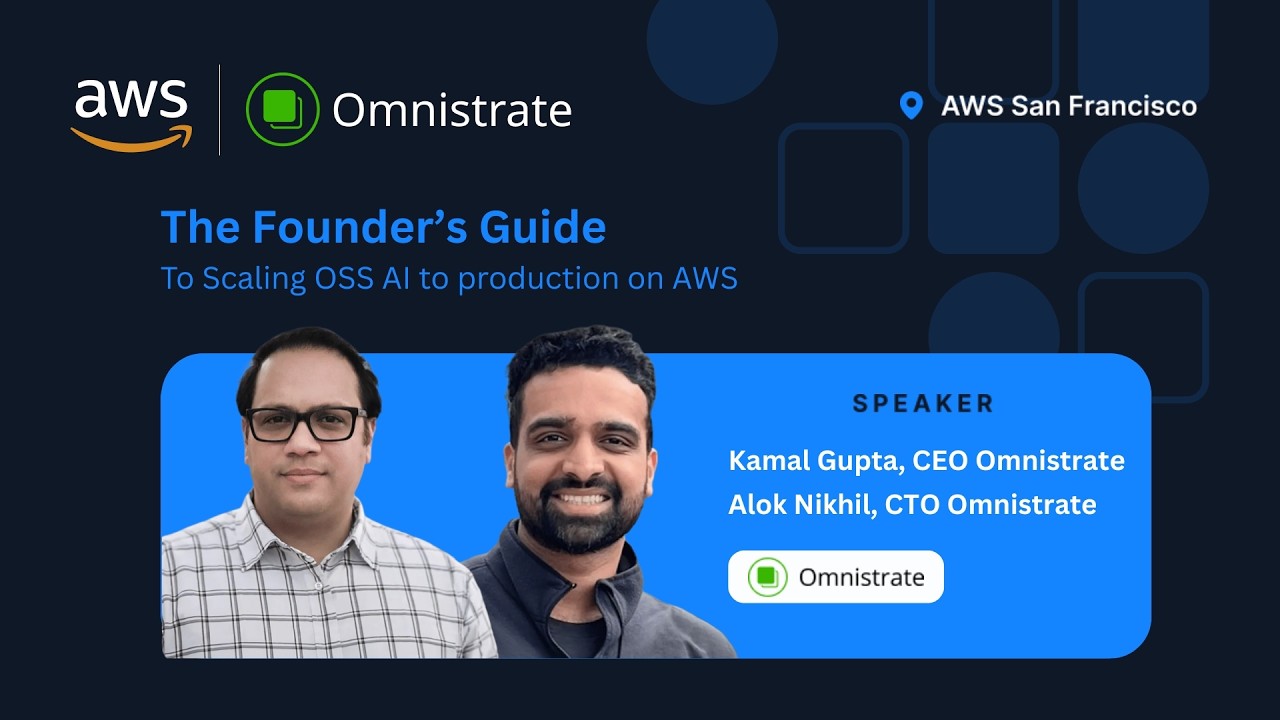
Episode 35: The Founder's Guide to Scaling Open Source AI Products to Production on AWS
Omnistrate co-founders Kamal Gupta and Alok Nikhil map the road from open source adoption to revenue: the four ingredients of monetization (project, enterprise features, distribution, go-to-market) and the three business models open to open source AI companies, product-led growth, AWS Marketplace co-sell, and enterprise sales. Alok closes with a live demo that turns vLLM into a managed inference service with a self-service customer portal, showing why distribution needs a control plane and why a Marketplace listing alone gets you discovered but not paid.