
SaaS Deployment Models, From Fully Hosted to BYOC
Michael Cooper, Kamal Gupta, Bill Tarr and Markus Kaiser walk through the main SaaS deployment models, from fully hosted to private VPC to bring-your-own-cloud (BYOC). Kamal explains how the control plane came out of early AWS services like S3 and RDS, and why a deployment that depends on people running scripts is not SaaS. Bill compares silo and pooled tenancy, and contrasts PrivateLink, VPC peering and VPC Lattice for connecting to customer accounts. Markus covers data sovereignty, latency and intellectual property as reasons customers demand deployment in their own accounts, and Kamal argues Terraform alone cannot manage SaaS infrastructure. Founders weighing hosted against BYOC will leave with a way to work backwards from their customers' requirements.
Timestamps
00:00Welcome and introductions of the AWS and Omnistrate panel02:30Where did the SaaS control plane come from at AWS?06:30Why real SaaS must be self-serve and fully automated09:30Silo versus pooled SaaS: the homes and apartments analogy14:00Databricks and deploying the app plane in customer accounts17:00Why does data sovereignty shape where SaaS runs?22:00One control plane or one per region?26:00Why Terraform alone falls short for managing SaaS29:30What does private SaaS in a customer VPC look like?30:30PrivateLink, VPC peering and VPC Lattice compared36:30Which networking options must a SaaS vendor support?41:30BYOC and the Databricks effect on customer expectations46:30How is BYOC SaaS different from shipping an installer?55:00What should an early-stage SaaS founder decide first?About This Episode
- What is "SaaS Deployment Models, From Fully Hosted to BYOC" about?
- Michael Cooper, Kamal Gupta, Bill Tarr and Markus Kaiser walk through the main SaaS deployment models, from fully hosted to private VPC to bring-your-own-cloud (BYOC). Kamal explains how the control plane came out of early AWS services like S3 and RDS, and why a deployment that depends on people running scripts is not SaaS. Bill compares silo and pooled tenancy, and contrasts PrivateLink, VPC peering and VPC Lattice for connecting to customer accounts. Markus covers data sovereignty, latency and intellectual property as reasons customers demand deployment in their own accounts, and Kamal argues Terraform alone cannot manage SaaS infrastructure. Founders weighing hosted against BYOC will leave with a way to work backwards from their customers' requirements.
- What topics does this episode cover?
- This episode is filed under Cloud Infrastructure, SaaS Strategy on Agentic SaaS Talks.
- How long is this episode, and when was it published?
- "SaaS Deployment Models, From Fully Hosted to BYOC" runs 61 min and was published on July 15, 2024.
- What are the key moments in this episode?
- Key moments include: Where did the SaaS control plane come from at AWS?; Why real SaaS must be self-serve and fully automated; Silo versus pooled SaaS: the homes and apartments analogy; Databricks and deploying the app plane in customer accounts; Why does data sovereignty shape where SaaS runs?; One control plane or one per region?; Why Terraform alone falls short for managing SaaS; What does private SaaS in a customer VPC look like?. The timestamps on this page jump to each one on YouTube.
Related Episodes

Episode 35: The Founder's Guide to Scaling Open Source AI Products to Production on AWS
Omnistrate co-founders Kamal Gupta and Alok Nikhil map the road from open source adoption to revenue: the four ingredients of monetization (project, enterprise features, distribution, go-to-market) and the three business models open to open source AI companies, product-led growth, AWS Marketplace co-sell, and enterprise sales. Alok closes with a live demo that turns vLLM into a managed inference service with a self-service customer portal, showing why distribution needs a control plane and why a Marketplace listing alone gets you discovered but not paid.
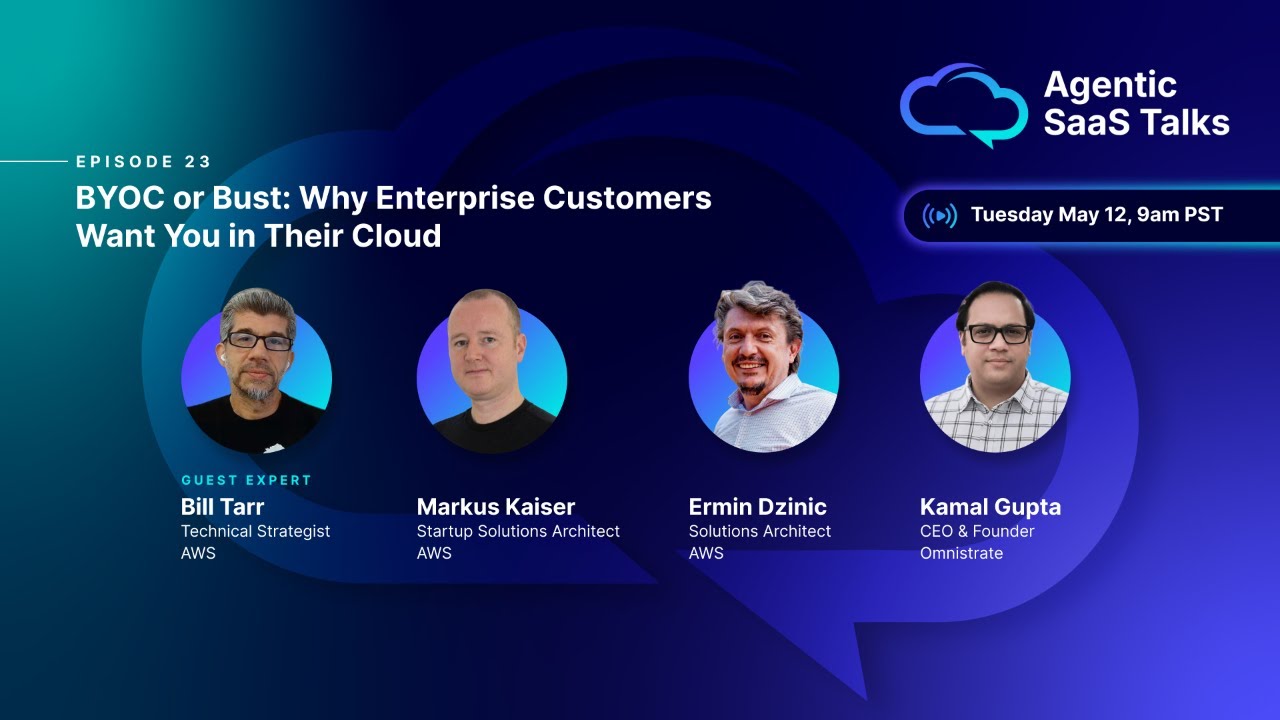
Episode 29: BYOC or Bust: Why Enterprise Customers Want You in Their Cloud
BYOC has shifted from a deployment option to a buying requirement. AWS solutions architects and Omnistrate's Kamal Gupta break down why enterprises now demand software in their own cloud, the security building blocks that make it work, and how agentic AI and data gravity are accelerating the move toward Bring Your Own Cloud.

Episode 24: Agentic SaaS Talks, 2025 Year in Review
Michael Cooper, Bill Tarr, Markus Kaiser and Ermin Dzinic review 2025 on Agentic SaaS Talks and make predictions for 2026. They trace the show from SaaS Mondays articles to the current name and 19 guest episodes, and Markus recalls AI coding hallucinating functions at the end of 2024 before it became a required skill by April or May. Bill revisits the Rox episode and the one-person unicorn, and the panel covers the HoneySales pivot, John Lorance on abstracting cloud primitives, and digital identity for people and agents. Predictions include fewer acqui-hires, data companies gaining, LLMs becoming commodities, control planes growing in importance, and context engineering as the word of 2026. Listeners get a candid account of what changed for SaaS founders and engineers during 2025.